
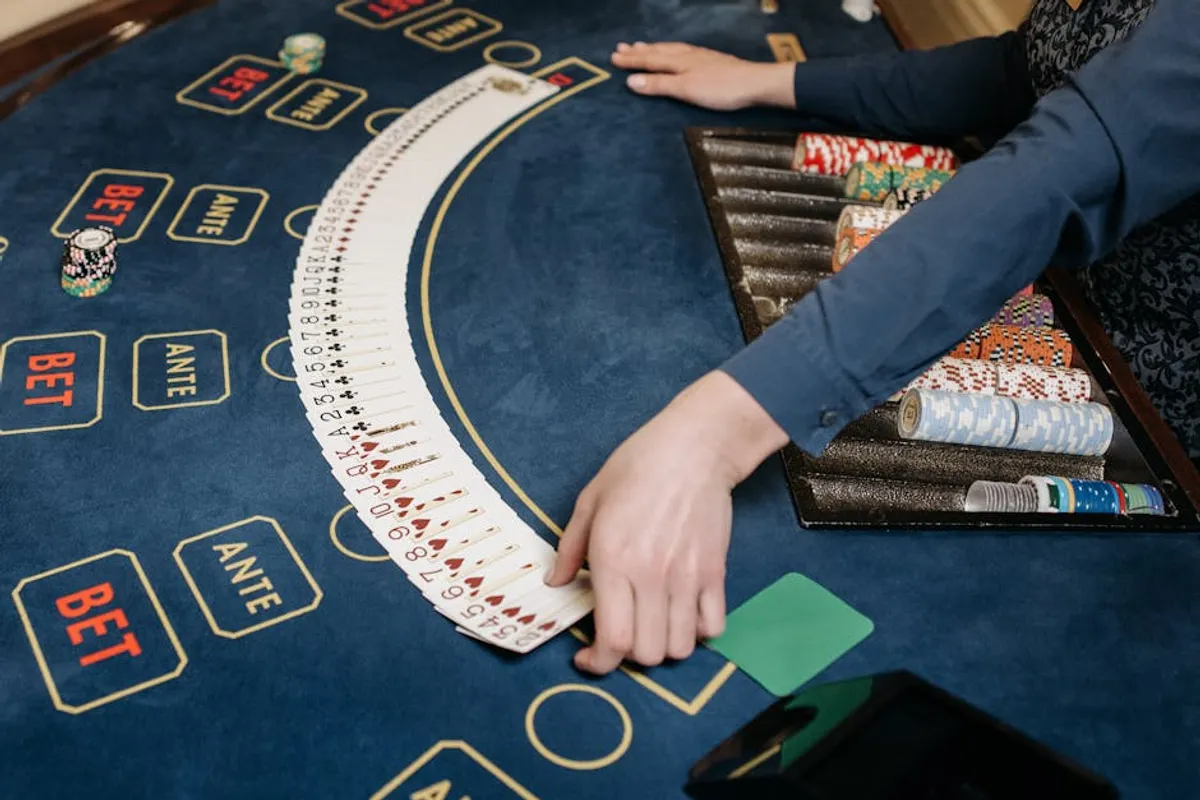
For individuals new to the world of casino gaming, the sheer variety of options can be daunting. Among the most popular and enduring choices are Blackjack, Roulette, and Baccarat. Each game offers a distinct experience, appealing to different preferences for strategy, pace, and reliance on chance. Understanding the fundamental mechanics and player involvement required for each can significantly inform a beginner’s choice, ensuring a more engaging and less overwhelming introduction to casino play.
Understanding Blackjack: The Goal and Basic Play
Blackjack, also known as twenty-one, is a card game played against a dealer. The objective is to achieve a hand total closer to 21 than the dealer's hand, without exceeding 21. Exceeding 21 results in an automatic loss, known as "busting."
Card Values and Hand Objective
Numbered cards (2-10) are worth their face value. Face cards (King, Queen, Jack) are each worth 10 points. An Ace can be valued as either 1 or 11 points, depending on which value benefits the hand most without busting. A "blackjack" is an initial two-card hand totaling 21 (an Ace and any 10-value card).
Core Decisions: Hit, Stand, Double Down, Split
After receiving two initial cards, players make decisions based on their hand total and the dealer's visible card (the "upcard").
- Hit: Request an additional card. This is done to increase the hand total, but carries the risk of busting.
- Stand: Decline additional cards, keeping the current hand total. This is typically chosen when the hand is strong enough, or the risk of busting is too high.
- Double Down: Double the initial bet and receive only one more card. This option is usually available when a player has a strong starting hand (e.g., 9, 10, or 11) and believes the next card will improve it significantly.
- Split: If the initial two cards are a pair (e.g., two 8s), a player can split them into two separate hands, placing an additional bet equal to the original on the second hand. Each new hand is then played independently.
Pro Tip: Mastering basic Blackjack strategy, which involves specific decisions for every possible player hand and dealer upcard combination, significantly reduces the house edge. Beginners should consult and practice with a basic strategy chart, often available online or in casino guides, before playing for real stakes.
Best for: Players who enjoy strategic decision-making, mental calculation, and a game where player choices directly influence outcomes.
Decoding Roulette: Chance and Betting Options
Roulette is a game of pure chance, involving a spinning wheel with numbered pockets and a small ball. Players bet on where the ball will land. The game requires no skill beyond understanding the various betting options.
The Wheel and Ball
A standard European roulette wheel features 37 pockets: numbers 1 through 36 (alternating red and black) and a single green 0. American roulette wheels add an additional green "00" pocket, increasing the house edge. The dealer spins the wheel and drops a ball, which eventually settles into one of the numbered pockets.
Inside vs. Outside Bets
Bets are categorized by their placement on the betting layout, which corresponds to the wheel's numbers and colors.
- Inside Bets: These are placed directly on individual numbers or small groups of numbers. They offer higher payouts but lower odds of winning. Examples include:
- Straight Up: A bet on a single number (payout 35:1).
- Split: A bet on two adjacent numbers (payout 17:1).
- Street: A bet on three numbers in a row (payout 11:1).
- Corner: A bet on four numbers that meet at a corner (payout 8:1).
- Line: A bet on six numbers across two adjacent rows (payout 5:1).
- Outside Bets: These cover larger groups of numbers and are placed on areas outside the numbered grid. They offer lower payouts (typically 1:1 or 2:1) but higher odds of winning. Examples include:
- Red/Black: A bet on the ball landing on any red or black number (payout 1:1).
- Odd/Even: A bet on any odd or even number (payout 1:1).
- High/Low: A bet on numbers 1-18 (low) or 19-36 (high) (payout 1:1).
- Dozens: A bet on the first (1-12), second (13-24), or third (25-36) dozen numbers (payout 2:1).
- Columns: A bet on one of the three vertical columns of numbers (payout 2:1).
Best for: Individuals who prefer a game based purely on chance, enjoy a wide range of betting options, and appreciate a slower, more social pace.
Navigating Baccarat: Simplicity and Low House Edge
Baccarat is often perceived as a sophisticated game, but its core mechanics are remarkably simple for players. The game involves comparing two hands: the "Player" and the "Banker." The objective is to bet on which hand will have a total closer to nine.
Player, Banker, Tie Bets
Unlike Blackjack, players do not make decisions on how to play their hand in Baccarat. Instead, they choose one of three main bets before cards are dealt:
- Player: A bet that the Player hand will win. This bet typically pays 1:1.
- Banker: A bet that the Banker hand will win. This bet also pays 1:1, but a 5% commission is usually deducted from winnings due to the Banker hand's slightly higher statistical advantage.
- Tie: A bet that both hands will have the same total. This bet offers a much higher payout (typically 8:1 or 9:1) but has a significantly lower probability of occurring, making it a high-risk wager.
Card Dealing and Scoring
Two cards are dealt to both the Player and Banker hands. Card values are as follows: Aces are worth 1, cards 2-9 are worth their face value, and 10s and face cards (King, Queen, Jack) are worth 0. The hand total is determined by summing the card values; if the sum is a two-digit number, only the second digit counts. For example, a hand with a 7 and a 6 totals 13, making its Baccarat value 3. A hand with a 10 and an 8 totals 18, making its Baccarat value 8.
Additional cards may be drawn for either hand based on a fixed set of rules, which the dealer executes automatically. Players do not need to know these rules; their only decision is where to place their initial bet.
Best for: Beginners seeking a very simple game with minimal player decisions, a relatively fast pace, and one of the lowest house edges among casino games (especially on the Banker bet).
Choosing Your First Game: A Comparative Look
When deciding which game to try first, consider these distinctions:
- Complexity and Player Involvement:
- Blackjack: High complexity due to strategic decisions (hit, stand, double, split) influencing outcomes. Requires active participation and learning basic strategy.
- Roulette: Low complexity. No player decisions after placing a bet. Purely observational.
- Baccarat: Very low complexity for players. Only decision is the initial bet. All card actions are handled by the dealer.
- House Edge (Typical):
- Blackjack: Can be as low as 0.5% with optimal basic strategy.
- Roulette (European): Approximately 2.7% (single zero).
- Roulette (American): Approximately 5.26% (double zero).
- Baccarat: Banker bet ~1.06%; Player bet ~1.24%; Tie bet ~14.36%.
- Pace of Play:
- Blackjack: Moderate to fast, depending on the number of players and their decision speed.
- Roulette: Slower, as bets are placed, the wheel spins, and payouts are made for each round.
- Baccarat: Generally fast-paced, especially in mini-baccarat versions, as player decisions are minimal.
Getting Started: Practice and Bankroll Management
Before engaging in real-money play, beginners should take advantage of free-play versions of these games, often available online. This allows for rule comprehension and strategy practice without financial risk. Regardless of the chosen game, effective bankroll management is critical. Set a budget for each playing session and adhere to it strictly. Understand that all casino games have a house edge, meaning the casino always has a long-term advantage, making disciplined play essential for entertainment and responsible gaming.
Frequently Asked Questions
Which game is easiest for beginners to learn?
Baccarat is generally considered the easiest game for beginners, as players only need to choose between three main bets (Player, Banker, Tie) and do not make any further decisions during gameplay.
Which game offers the best odds for the player?
Blackjack, when played with optimal basic strategy, typically offers the lowest house edge, often below 1%, providing the best odds for players who apply skill and strategy.
Can I play these games for free?
Yes, many online platforms offer free-play or demo versions of Blackjack, Roulette, and Baccarat. This allows beginners to learn the rules, practice strategies, and familiarize themselves with the gameplay without risking real money.
What does "house edge" mean?
The house edge is the built-in advantage that the casino has over players in any game. It is expressed as a percentage of the player's initial bet and represents the average profit the casino expects to make from each wager over the long term.